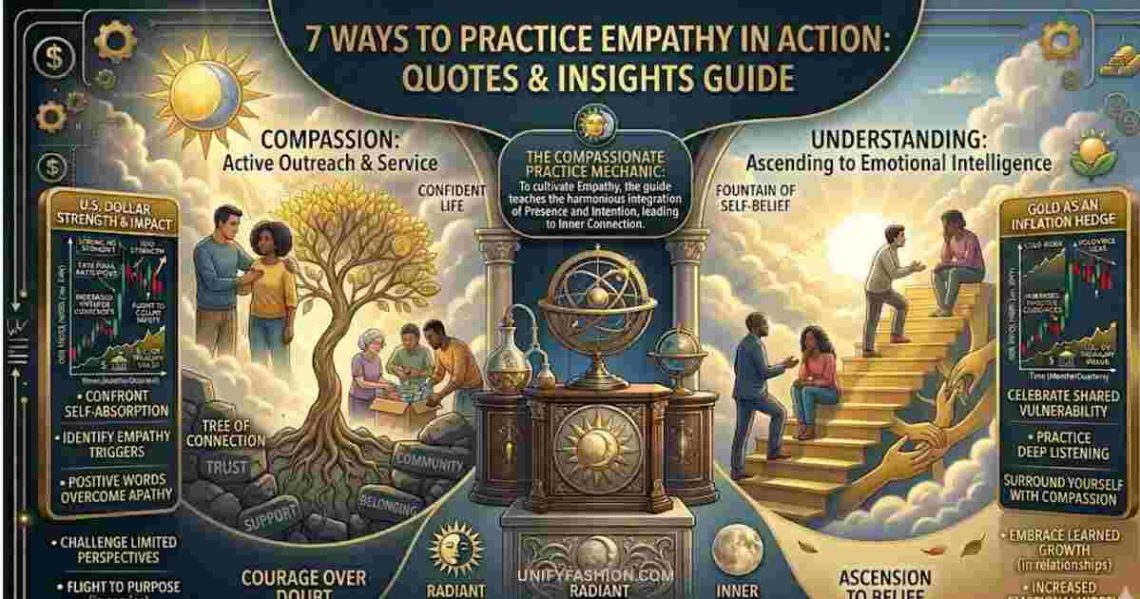
Empathy is more than understanding someone’s feelings it’s acting upon that understanding in meaningful ways. When we transform into action, we build deeper connections, resolve conflicts, and foster positive social interactions. In today’s world, where distractions and individualism dominate, is a skill that must be consciously cultivated and practiced.
This guide explores empathy from multiple angles: general quotes, short and student-focused quotes, psychological insights, and practical applications. By the end, you’ll have a comprehensive understanding of how to integrate into everyday life, strengthen relationships, and nurture emotional intelligence.
1. Empathy in Action
Empathy in action means recognizing another person’s experience and responding with care, support, and understanding. It bridges the gap between knowledge and behavior, turning compassion into tangible deeds.
Quotes on Empathy in Action
Famous thinkers have long emphasized the importance of actionable . Alfred Adler once said:
- “Empathy is seeing with the eyes of another, listening with the ears of another, and feeling with the heart of another.”
This quote highlights that is multi-dimensional: observing, listening, and feeling. without action remains abstract, while actionable strengthens trust, deepens human connections, and promotes harmony.
Bill Bullard adds:
- “The highest form of knowledge is ”
This emphasizes that understanding others’ perspectives is not merely an emotional skill but also an intellectual one. When combined with deliberate action, can lead to constructive problem-solving, conflict resolution, and social cohesion.
-
“Empathy is seeing with the eyes of another, listening with the ears of another, and feeling with the heart of another.” Alfred Adler
-
“Compassion is the wish to see others free from suffering.” Dalai Lama
-
“Whenever you feel like criticizing anyone, just remember that all the people in this world haven’t had the advantages that you’ve had.” F. Scott Fitzgerald
-
“When we give cheerfully and accept gratefully, everyone is blessed.” Maya Angelou
-
“If you judge people, you have no time to love them.” Mother Teresa
-
“The highest form of knowledge… is .” Bill Bullard
-
“Empathy is about finding echoes of another person in yourself.” Mohsin Hamid
-
“Only the development of compassion and understanding for others can bring us the tranquility and happiness we all seek.” Dalai Lama
-
I saw people die, I saw loved ones separated, I saw cruelty and hunger on a daily basis. All that proved to me that nothing is more important than empathy for another human being’s suffering. Nothing. Not a career, not wealth, not intelligence, certainly not status. We have to feel for one another if we’re going to survive with dignity. Audrey Hepburn
-
Blessed are you who/ chooses to show up without judgment/with little gifts or small acts of practical help./You know the gift of compassion.” Kate Bowler
Quotes on Empathy in Action in English
English literature and motivational resources frequently highlight empathy as an actionable virtue:
- “Compassion and empathy are the antidotes to cruelty and indifference.”
- “Understanding others’ feelings is the first step to meaningful action.”
These quotes remind us that empathy is a practical skill, not just a feeling. For example, volunteering, mentoring, or simply offering a listening ear are everyday ways to act empathetically. Integrating these behaviors strengthens emotional intelligence (EI), a concept widely studied in psychology Emotional intelligence.
Quotes on Empathy in Action for Students
Students often navigate complex social dynamics. Empathy in action helps them build healthy friendships, resolve conflicts, and create inclusive environments. Notable quotes include:
- “Empathy is the key to effective teamwork and friendship in school.”
- “When you act with empathy, you create a ripple of understanding in your classroom.”
Educators encourage role-playing exercises, peer mentorship, and community service projects to allow students to experience empathy in action. Research shows that students who practice empathy develop better communication skills, higher academic engagement, and stronger social bonds Empathy.
Inspirational Quotes on Empathy in Action
-
“Do not wait for leaders; act with in your daily life.”
-
“Small acts of can transform a moment, a relationship, or a community.”
-
Such inspirational statements reinforce the idea that every individual can make a difference. By incorporating into daily decisions helping a peer, comforting a friend, or listening attentively we build a culture of care and understanding.
-
-
-
-
-
-
-
-
-
-
-
-
-
-
-
-
-
-
-
2. Short Quotes on Empathy
Short quotes are powerful because they distill wisdom into memorable, actionable statements. They are particularly effective for students, social media, and daily reminders.
- “Empathy is action in motion.”
- “Feel with others, act with care.”
- “Empathy is the bridge between understanding and connection.”
Using short quotes regularly can reinforce empathetic behavior subconsciously. They serve as mini-mantras that encourage reflection and self-awareness. In classrooms, teachers often post these quotes to promote emotional intelligence and mindful interactions among students.
Short quotes are effective because human memory retains concise messages more easily. Students and adults alike can repeat them, use them as affirmations, and integrate them into daily habits, transforming awareness into habitual action.
3. Empathy Quotes for Students
Students are uniquely positioned to learn early, which shapes lifelong social and emotional skills. Quotes and short phrases help them internalize the value of understanding others.
Quotes on Empathy for Students
- “Walk a mile in someone else’s shoes before judging them.”
- “Listen to understand, not to reply.”
Such quotes emphasize active listening, perspective-taking, and patience, crucial skills in a collaborative academic environment. Empathy allows students to navigate conflicts, work effectively in teams, and foster inclusive classroom cultures.
Short Quotes on Empathy for Students
- “Kindness begins with empathy.”
- “Empathy is learning through others’ eyes.”
- “Understand to connect.”
These short, actionable quotes are easy for students to remember and apply. They can serve as prompts for classroom discussion, reflective journaling, or peer mentoring activities, helping translate abstract values into practical behavior.
-
“Be kind. For everyone you meet is fighting a battle you know nothing about.” Ian Maclaren, author.
-
“Before you criticise someone, walk a mile in their shoes.” Native American proverb
-
“All nightingales understand one another, but we men, will we ever manage to understand one another?” Yevgeny Yevtushenko, poet.
-
“The highest expression is accepting and non-judgmental.” Carl Rogers, psychologist.
-
“Seeing with the eyes of another, listening with the ears of another and feeling with the heart of another” Alfred Adler, psychiatrist.
-
“If what I say resonates with you, it’s merely because we’re branches of the same tree.” William Butler Yeats, writer
-
“If you look into someone’s face long enough, eventually you’re going to feel that you’re looking at yourself.” Paul Auster, writer
-
“Too often we underestimate the power of a touch, a smile, a kind word, a listening ear, an honest compliment, or the smallest act of caring, all of which have the potential to turn a life around.” Leo Buscaglia, writer.
-
“The great gift of human beings is that we have the power, we can all sense a mysterious connection to each other.” Meryl Streep, actor.
-
“I believe is the most essential quality of civilization.” Roger Ebert, film critic
-
“If you are in conflict with another person, the first thing you should do is try to understand it thoroughly. Looking in depth will show you his suffering and then you will not want to hurt her or punish her or make her suffer, but you will accept it as she is and will try to help her.” Thich Nhat Hanh, monk.
-
“Let those who desire Buddhahood not train in many Dharmas but only one. Which one? Great compassion. Those with great compassion possess all the Buddha’s teaching as if it were in the palm of their hand.” Buddha, spiritual teacher.
-
“If you want others to be happy, practice compassion. If you want to be happy, practice compassion.” Dalai Lama.
-
“In my younger and more vulnerable years my father gave me some advice that I’ve been turning over in my mind ever since. ‘Whenever you feel like criticizing any one…just remember that all the people in this world haven’t had the advantages that you’ve had.’” Francis Scott Fitzgerald, writer.
-
“If we could read the secret history of our enemies, we should find in each one’s life sorrow and suffering enough to disarm all our hostility.” Henry Wadsworth Longfellow, poet.
-
“Empathic awareness is born out of the sense that others, like ourselves, are unique, mortal beings. When we empathise with another, it’s because we recognise her fragile finite nature, her vulnerability, and her one and only life.” Jeremy Rifkin, economist and sociologist.
-
“Blessed is he who can say to himself: I have dried a tear.” Giuseppe Giusti, poet.
-
“I have laboured carefully, not to mock, lament, or execrate human actions, but to understand them.” Baruch Spinoza, philosopher.
-
“There is a part of each of us that is adrift and foolish, at times strongly inclined to roaming and breathing nothing but our own solitude; so it is by finding this part of ourselves that we can understand you.” Natalia Ginzburg, writer.
-
“Look out the other’s window. Try to see the world as your patient sees it.” Irvin D. Yalom, writer.
-
“I’m talking to you as if I’ve known you for centuries. This always happens when two understand each other.” Ernest Hemingway, writer and journalist.
-
“An effective way to combat anxiety is to worry less about yourself and more about others. When we truly understand the difficulties of others, our own lose their importance.”
-
Dalai Lama.
-
“What is the essential condition for dialogue? It is the ability to see things from the other’s point of view.” Paolo Flores d’Arcais, writer.
-
“In the confusion we stay with each other, happy to be together, speaking without uttering a single word.” Walt Whitman, poet.
4. Psychology/Analytic Angle
Psychologists define as both a cognitive and emotional skill. Cognitive allows understanding others’ thoughts, while emotional enables sharing feelings and responding appropriately.
Psychology Quotes About Empathy
- “Empathy is not only a moral choice but also a neurological response that fosters cooperation.”
- “Understanding the emotions of others improves cognitive and social functioning.”
Empathy activates specific brain regions, including the mirror neuron system, which helps humans simulate others’ experiences. Studies indicate that practicing reduces stress, enhances relationships, and improves conflict resolution.
Practical Psychological Insights
- Perspective-Taking: Actively imagining another person’s thoughts or feelings enhances accuracy.
- Active Listening: Full attention to verbal and non-verbal cues promotes genuine understanding.
- Compassionate Action: Empathy is incomplete without action; offering help or guidance reinforces connection.
By integrating these exercises into daily routines, individuals improve their social intelligence and create positive interpersonal environments. Psychologists also suggest journaling, mindfulness, and reflective exercises to internalize empathetic responses.
FAQs
1. Why is empathy in action important?
Empathy in action converts understanding into tangible support, fostering trust, cooperation, and healthier relationships.
2. How can students practice empathy?
Through active listening, role-playing, community service, peer mentorship, and reflective exercises.
3. Can empathy be learned or improved?
Yes. With practice, mindfulness, and self-reflection, empathy can be developed over time.
4. How do short empathy quotes help?
They serve as memorable reminders, reinforcing empathetic behavior and encouraging habitual kindness.
5. What is the psychological benefit of empathy?
Empathy enhances emotional intelligence, reduces conflicts, strengthens social bonds, and improves overall mental well-being Empathy.
Final Thoughts
Empathy in action is about understanding, connecting, and responding thoughtfully. Quotes, short reminders, student exercises, and psychological insights all provide practical ways to cultivate this essential skill.
By consistently practicing empathy, individuals contribute to more compassionate communities, better interpersonal relationships, and personal growth. Every act of understanding, listening, and helping strengthens not only others but also our own emotional intelligence, resilience, and sense of fulfillment.